Earn to Die
- 4.8
- Rating
- 1.00M
- Installs
- $1.49
- Price

 Analysis by App-foxy
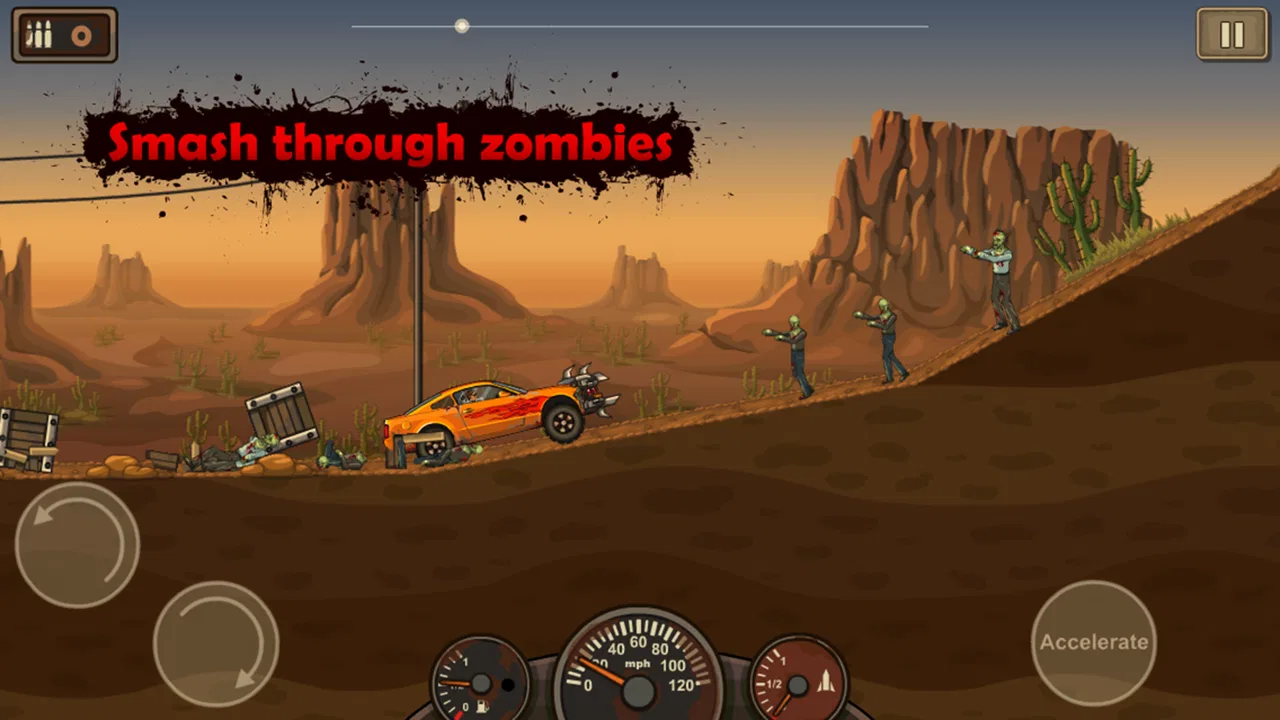
Zombie racing usually sounds like a simple idea, but Earn to Die works because it turns every short drive into a small problem to solve. I pick a vehicle, push through a road filled with undead obstacles, and try to get farther before the car loses its usefulness. The appeal is immediate: it is easy to understand, quick to start, and built around the satisfying contrast between a weak early vehicle and the stronger machine I can gradually work toward.
This is a paid racing game from Not Doppler, released on March 11, 2013. It costs $1.49, carries a Teen age rating, and has reached over a million installs. Its average score is 4.8 from around 111 thousand ratings, with roughly 6.7 thousand written reviews. Those figures suggest that the compact zombie-driving formula has remained attractive to a large audience, but they do not replace the more important question: does it still feel good to play now?
My short answer is yes, provided you want a focused arcade game rather than a deep driving simulator. The fun comes from judging momentum, using upgrades intelligently, and accepting that some failed attempts are part of the route forward. It is not designed for realistic handling, long-form exploration, or a huge collection of racing modes. Instead, it concentrates on one loop and makes that loop increasingly demanding.
You May Also Like

 Blood Strike: 2.5 Anniversary
Blood Strike’s Loadouts Turn Every Drop Into a Tactical Gamble
A close look at Blood Strike’s custom loadouts: how fast access to signature weapons reshapes its battle royale rhythm, rewards preparation, and narrows the gap between fights.

 Pandora - Music & Podcasts
Pandora’s Music Is Easy to Start, but Harder to Recover
Pandora’s strength is its low-effort path from a seed to a station. Its weak spot is how much confidence it asks you to place in connection, setup, and quiet recovery.

 8 Ball Pool
 Is Built on Rivalries, Rematches, and Routine
A close look at the rivalries, rematches, shared routines, and unanswered safety questions that turn a quick pool match into a persistent mobile community.

 Samsung Music
’s Quiet Strength Is Playing What You Already Own
Its reach comes less from spectacle than from dependable access to a personal library. That simplicity is both the app’s strongest retention engine and its ceiling.

 AccuWeather: Weather Radar
AccuWeather Review: A Quick, Clear Forecast for Everyday Decisions
For everyday plans, the best forecast is the one you can understand quickly. AccuWeather makes rain timing, radar, and local conditions easy to act on, with a few trade-offs.

 Hill Climb Racing
Why Hill Climb Racing Still Turns Crashes Into One More Run
A tiny car, a bumpy hill and one more upgrade: Hill Climb Racing keeps resurfacing because its simple chaos makes every near-miss feel personal.
More From Our News Desk



How the game feels when the road gets faster
I find the game’s faster stretches most interesting when they turn a familiar route into a test of judgment: carrying speed can help, but pushing blindly may leave the vehicle poorly positioned for what comes next. In this section, I’d focus on how to read that change in pace and choose when a risky run is worth it. That also leads naturally to a practical question: how well does the game suit the device and player you have in mind?
Speed is about momentum, not simulation
The first thing I noticed is that the sensation of speed depends less on realistic physics and more on how well I maintain forward movement. A good run feels fast because the car keeps climbing, landing, and pushing through interruptions without losing its rhythm. A poor run feels slow even when the vehicle is moving, because a bad landing or an awkward collision breaks the flow.
That distinction matters when deciding whether this game suits you. If you expect the precise cornering of a conventional racing title, you may find the driving fairly limited. The road is a challenge course rather than a circuit built around clean racing lines. My attention goes toward obstacles, jumps, fuel management, and the condition of the vehicle instead of braking at a perfect apex.
The controls are approachable enough for short sessions. I do not need to learn a complicated button layout before attempting a run. The challenge comes from timing and judgment: when to keep the nose down, when to protect the vehicle from a rough landing, and when a risky push is worth taking. That makes the game friendly at the beginning while leaving room for mistakes that feel like my responsibility rather than random punishment.
One useful way to play is to stop treating every attempt as a race that must succeed. I use early runs to learn where the road changes character and to see which obstacles consistently cost me distance. This turns failure into reconnaissance. Instead of spending resources blindly, I can identify whether my problem is insufficient speed, poor control in the air, or a vehicle that simply needs improvement.
Why upgrades change the pace of a session
The upgrade-driven structure gives the game its strongest sense of progression. A car that struggles at the beginning can become much more capable after I invest in the right improvements. The important choice is not merely buying whatever becomes available. I have to decide whether my current weakness is acceleration, endurance, control, or the ability to cope with the next section of road.
This creates a practical trade-off. Improving the part that feels most frustrating can make the next attempt more comfortable, but a more balanced approach may carry me farther overall. I often prefer fixing the problem that causes repeated failures rather than chasing a general improvement. If I keep running out of momentum before a climb, speed matters more than an upgrade that only helps after I have already cleared the difficult section.
The smartest upgrade is usually the one that removes a repeated failure point, not the one that sounds most powerful. That is especially useful for players who are tempted to replay the same stretch without changing their approach. A small adjustment to the vehicle can be more valuable than several attempts made with exactly the same setup.
What happens during a heavy-use play session
Longer sessions are built from repeated attempts, and that repetition is both the game’s strength and its main limitation. Each run is easy to understand, so I can quickly try again after a crash. The restart-friendly structure works well when I have only a few spare minutes, but it can also make a determined session feel like a loop of similar decisions if I am not actively working toward a specific improvement.
The heaviest moments in play are not necessarily dramatic in a technical sense. They happen when several physical events arrive together: a jump, a poor landing, a cluster of zombies, and a vehicle that is already damaged or short on useful momentum. These moments demand quick reactions, but they also expose the limits of the simple control model. When the car begins to tumble, recovery can feel more like managing a bad situation than performing a precise rescue.
I found it helpful to separate “safe progress” attempts from “maximum distance” attempts. On a safe run, I avoid unnecessary risks and focus on learning the course. On a distance run, I accept that the car may suffer if the reward is reaching a new section. Mixing those goals can be frustrating because cautious play may not produce enough progress, while aggressive play can waste a promising attempt.
Another practical habit is to pause before spending accumulated earnings. If I immediately buy the most visible improvement, I may leave the actual obstacle untouched. Watching two or three failed runs first gives me a clearer idea of what is holding the vehicle back. This is a small discipline, but it makes the progression feel less wasteful and reduces the sense that I am grinding without a plan.
Recovery after a mistake
Recovery is central to the experience. The game is not only asking whether I can drive forward; it is asking whether I can recover when the vehicle lands badly or meets an obstacle at the wrong angle. Some mistakes can be corrected with careful control, while others effectively end the attempt. Learning that difference is part of the skill curve.
I appreciate that the game makes recovery meaningful without turning every error into a complicated procedure. The basic idea is easy to grasp: preserve momentum when possible, avoid making a bad landing worse, and recognize when the run is no longer worth forcing. That last point is important. Continuing a doomed attempt can be less useful than accepting the failure and returning with a better upgrade or a different approach.
For a player who dislikes restarting, this may be the biggest source of friction. The game’s rhythm depends on trying again, and it does not offer the kind of forgiving, exploratory driving that lets me wander around after a mistake. On the other hand, players who enjoy mastering a route through repetition will probably find the recovery loop satisfying because improvement is easy to notice.
Reliability, device demands, and who should play
I’d weigh reliability less by expecting a modern racing showcase and more by asking whether the game’s focused, repeatable format fits the way I play. A short test on your own phone is a sensible way to judge comfort, especially if you plan to play during breaks or use older hardware. From there, the key decision is whether repeated attempts and a Teen-rated zombie theme match your tastes.
A stable fit for short, repeatable play
Because the game is an older, focused racing title, I find its presentation less demanding than modern games built around large environments or elaborate online systems. The experience is centered on driving, obstacles, upgrades, and repeated attempts rather than a constantly expanding world. That focused design makes it a sensible choice when I want something I can open, understand, and play without committing to a long session.
The current version is 1.0.40, and the listed minimum operating system is Android 4.4. That broad compatibility is useful for people using older Android hardware, although minimum compatibility should not be confused with an identical experience on every device. A phone with a modest screen, aging battery, or limited available storage may still make any game less comfortable, even when the operating system is supported.
I would not describe this as a resource-heavy game based on what it asks the device to do. It does not present itself as a visually ambitious open-world racer, and its compact structure should be easier to accommodate than a large contemporary racing download. Still, long repeated sessions can be harder on an older phone than a quick test run. Heat, battery condition, screen responsiveness, and background activity can affect how enjoyable the controls feel.
When I play on a device with limited battery, I treat it as a short-session game rather than something to leave running for hours. That is not a criticism of the design; it matches the natural shape of the experience. A few attempts during a commute, a waiting room, or a break can feel more satisfying than trying to turn it into a marathon.
Where the game feels dependable and where it feels dated
The simple structure helps reliability because there are fewer layers competing for attention. I am not managing a large online account, coordinating with other players, or waiting for a complex world to load before I can enjoy the central activity. The game gets to its main idea quickly, which is one reason it remains approachable despite its age.
Its age is also visible in the overall design philosophy. Players accustomed to modern racing games may expect more variety, smoother presentation, richer customization, or a broader selection of activities. This title is narrower. That narrowness is not automatically a flaw, but it means the value depends heavily on whether you enjoy repeating a carefully defined driving challenge.
The Teen rating is worth keeping in mind for families choosing games. The zombie theme and vehicle-based violence make it a better fit for older children and adults than for very young players. I would also avoid recommending it to someone specifically looking for a calm driving game. The subject matter and repeated crashes give it an arcade-survival tone, even though the controls themselves are easy to learn.
Who will get the most from it
I think it is a strong match for players who like upgrade loops, short arcade races, and the feeling of turning an underpowered vehicle into something capable. It also suits people who enjoy games where progress comes from understanding a route rather than collecting a huge number of unrelated activities. The clear objective makes it easy to recommend to a friend who wants a game that can be played in small pieces.
A realistic everyday scenario would be a ten-minute break between tasks. I can complete a few attempts, notice that one obstacle is repeatedly stopping me, save my earnings for a targeted improvement, and return later with a concrete plan. The game does not require me to remember a complicated story or rebuild a large setup after every break. That makes it more convenient than many racing alternatives that demand a longer uninterrupted session.
I would skip it if you want realistic driving, competitive multiplayer, a substantial narrative, or a broad collection of licensed cars and tracks. I would also be cautious if repeated failure quickly makes you angry. The game expects patience with trial and error, and its simple control scheme does not always provide the precision needed to rescue every awkward landing.
How it compares with other racing choices
Compared with a conventional circuit racer, this game is less about overtaking opponents and more about surviving a hazardous route. That makes it easier to pick up but less satisfying for someone who wants detailed racing lines, realistic braking, or head-to-head competition. Compared with an endless runner, it gives progression more weight because vehicle improvement changes what I can attempt, rather than asking only for a higher score on the same basic movement.
It also occupies a different space from large free-to-play racing games. Those alternatives may offer more visual variety, social systems, and long-term content, but they can feel like a commitment. Here, the paid entry price of $1.49 is straightforward, and the compact design is the main attraction. The trade-off is that I should not expect the breadth or production scale of a much larger racing package.
The best alternative depends on what I want from the genre. If I want a quick physics challenge with a strong upgrade loop, this remains a convincing choice. If I want a realistic driving test, a competitive community, or an expansive garage, another racing game will be better. The important thing is not to judge it by features it was never built around.
My verdict on performance and overall value
After looking at speed, heavy-use play, recovery, and device demands together, I see Earn to Die as a compact arcade racer that earns its place through focus. Its perceived speed comes from momentum and escalating obstacles, not from simulation. Its demanding moments come from repeated attempts and awkward recoveries, not from a complicated control system. That makes it accessible, but it also means the experience can become repetitive for anyone who needs constant novelty.
Not Doppler made a game that is easy to explain and surprisingly easy to keep playing: drive farther, learn from the failure, improve the vehicle, and try again. I like that the progression gives mistakes a purpose. I also like that the game can fit naturally into short breaks without requiring a large time investment. The main weakness is that the same focused loop can feel narrow once I have stopped enjoying the process of repeating it.
For Android users on a supported system, especially those who enjoy zombie themes and upgrade-based racing, the low asking price makes the decision fairly simple. I would recommend it to a friend who wants a self-contained arcade challenge rather than a full racing platform. I would not recommend it to someone seeking realistic handling or a constantly changing multiplayer experience.
My final judgment is positive but specific: this is best enjoyed as a series of deliberate, repeatable attempts. Play it when you are willing to study what went wrong, spend improvements carefully, and accept that progress may arrive one obstacle at a time. If that sounds satisfying, the game still delivers a clear and enjoyable ride. If it sounds like work, its straightforward design will probably reveal its limits very quickly.
FAQs for Earn to Die
01What is Earn to Die about?
Earn to Die is a driving and survival game in which you travel through a zombie-infested wasteland. You begin with a basic vehicle and must drive as far as possible while crashing through undead enemies and obstacles. Money earned during each attempt can be used to improve the engine, wheels, fuel capacity, weapons, and other parts, gradually helping you reach new areas.
02Is Earn to Die free to download and play?
Earn to Die may be available as a paid game or as a free version with advertising and optional purchases, depending on the platform and edition you download. Before installing it, check the current store listing for the exact price, advertising policy, and in-app purchase details. The core progression is generally based on completing runs and upgrading your vehicle.
03Does Earn to Die require an internet connection?
The main driving gameplay in Earn to Die can generally be enjoyed offline after the application has been installed. This makes it suitable for short sessions while traveling or when mobile data is unavailable. However, internet access may still be required for downloading the game, displaying advertisements, restoring purchases, checking updates, or using platform-related services.
04Is Earn to Die suitable for children?
Earn to Die has simple controls and an easy-to-understand upgrade system, but its main theme involves driving over zombies and destroying them with vehicles. Parents should review the age rating and content description shown in the Google Play Store or Apple App Store before downloading. Advertising, optional purchases, and difficulty may also be worth considering for younger players.
05What devices are compatible with Earn to Die?
Compatibility depends on the specific Earn to Die edition and the operating system version installed on your device. Most modern Android phones and iPhones should be able to run the game, although performance can vary on older hardware. Before downloading, check the official store page for minimum requirements, supported operating-system versions, storage needs, and the latest compatibility information.
Pros
- Simple controls make the game easy to pick up and play.
- Vehicle upgrades create a satisfying sense of progression.
- Different cars offer varied handling and play styles.
- Short runs work well for quick gaming sessions.
- Zombie-filled levels deliver entertaining arcade action.
Cons
- Progress can feel repetitive after playing the same routes repeatedly.
- Some upgrades require considerable grinding to unlock.
- Vehicle physics occasionally feel awkward or unpredictable.
- The game may become difficult without careful upgrade choices.
- Ads or in-app purchases may interrupt the free experience.

Earn to Die
Gallery